Advocates across the country: A Snapshot
Over the last three installments of this series, we traced how everyday people built Canadian medicare, how the courts have been used again and again to try to chip away at it, and how Tommy Douglas' unfinished "Phase Two" still waits to be built. This tells the story of an ever-evolving, unfinished project, full of tension and contestation.
As the federal government prepares to revert back to pre-2017 health transfer rates and takes a wait and see approach to enforcing the Canada Health Act, the push and pull of privatization continues at the provincial level.
Health care advocates continue the work of fighting privatization in our home provinces. From protests to forums to press conferences, here is a snapshot of four fights happening in four provinces this year, and what they tell us about the state of the movement.
Alberta: Bill 11 and the return of dual practice
As we covered in Part 2 in this series, Alberta's Bill 11 came into force this summer, opening the door for doctors to both bill patients privately and bill the public system in the very same practice.
This is the same dual-practice model that private clinics like Cambie Surgery Centre spent fourteen years in a legal battle trying to win in the courts. The evidence entered in the Cambie case was clear: allowing more private payment doesn't shrink public wait lists – it drains the public system of the health care workers it depends on.
With a pro-privatization premier at its helm, Alberta skipped the court case and went straight to legislating dual practice.
A coordinated effort by health care coalitions across the country is calling on premiers to support and protect public health care and push the federal government to enforce the Canada Health Act.
You can join the movement here: https://www.healthcoalition.ca/no-two-tier/
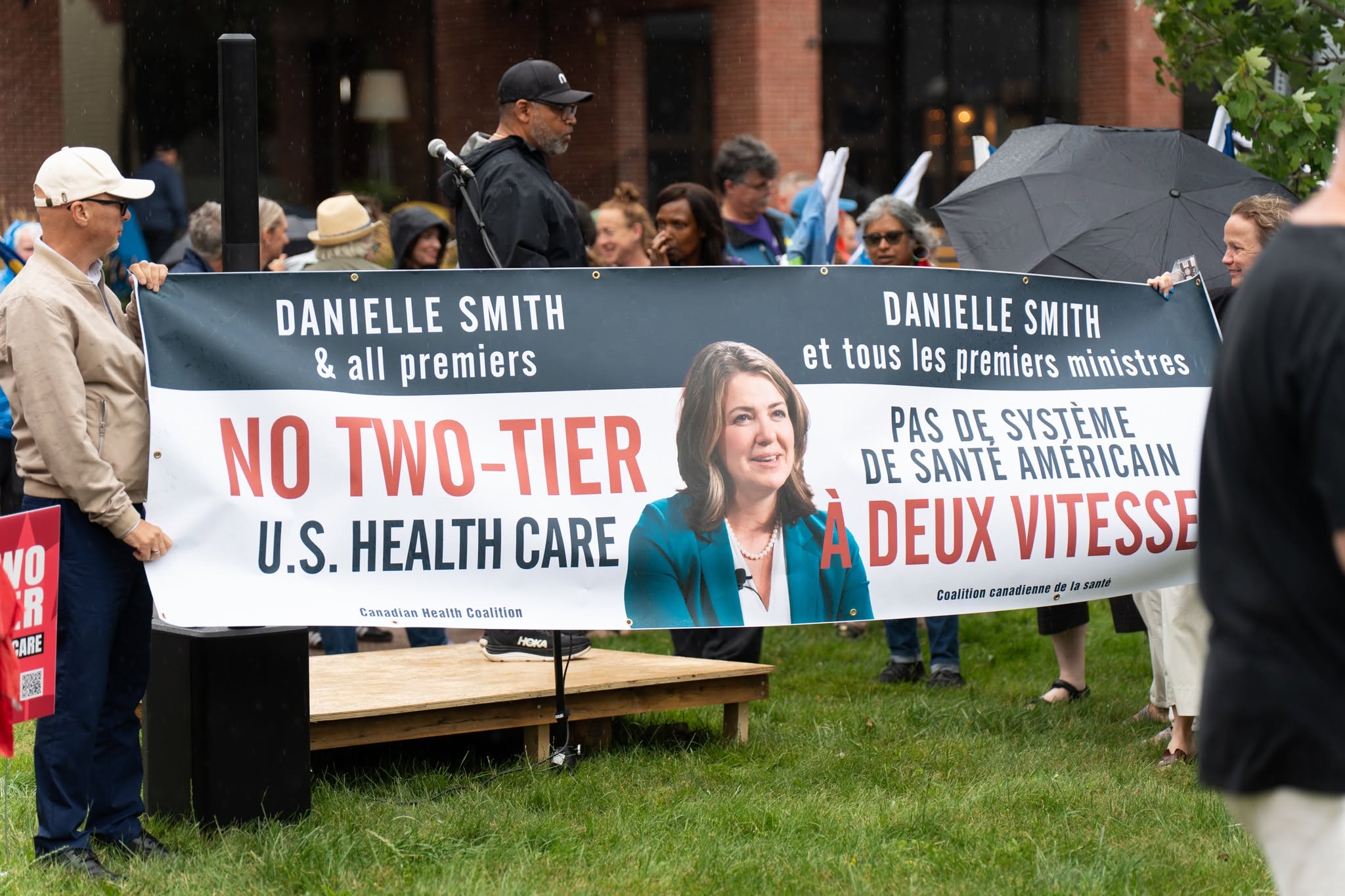
Public health care advocates rallied outside the premiers’ Council of the Federation meeting on July 22, 2026, demanding Canada’s premiers stop the spread of American-style, two-tier health care before it takes root nationwide. Photo by Parker Shahsavar.
Ontario: fighting a hospital privatization scheme at scale
In Ontario, the Ford government's expansion of private, for-profit surgical and diagnostic clinics has moved from pilot projects to a deliberate hollowing out of public hospital capacity. Researchers tracking Ontario's hospital funding describe a system being deliberately starved so that the private alternative looks more attractive by comparison.
The Ontario Health Coalition has organized rallies across the province, including an April protest and a May "Stop Ford's Hospital Privatization Train Wreck" rally, warning that every dollar and every surgeon redirected to a private clinic is a dollar and a surgeon not available to the hospital next door.

Ontario Health Coalition, March & Rally Against Ford's Hospital Privatization May 28, 2026. Photo by Tian Qio.
Manitoba: the fight over paid plasma
After the death of international student Rodiyat Alabede at a Winnipeg plasma clinic run by Grifols, the Manitoba Health Coalition has been demanding the province ban paid plasma donation outright, following the lead of provinces that got there years ago.
In British Columbia, the BC Health Coalition organized and won the 2018 Voluntary Blood Donations Act, which banned payment for blood and plasma donation. The lesson we learned then from survivors of the tainted blood scandal was that there is a real public risk when the blood supply is treated as a commodity.
Manitoba shouldn't need another death to catch up.

A throwback to BC Health Coalition's #nopaidplasma campaign, which led to the 2018 Voluntary Blood Donations Act.
New Brunswick: what "bringing it back in-house" actually takes
Let’s end on a hopeful story. New Brunswick's government recently ended its contract with Medavie Health Services NB to run the NB Health Link program for patients without a family provider, moving that work back under the regional health authorities.
Public health care campaigners, including the NB Health Coalition, welcomed the move and are now pushing the province to bring ambulance services, extra-mural care, nursing homes, and 811 Tele-Care back in-house too.
It's a useful reminder that outsourcing health services consistently fails on quality. When New Brunswick's auditor general looked at the ambulance contract with the same company, it found paramedic shortages had generated millions in surplus payments, which is a strange incentive to build into a system meant to answer 911 calls.
Alberta's experience with community lab privatization told the same story on a bigger scale: waiting times stretched from days to weeks, error rates climbed, and the province ultimately paid tens of millions of dollars just to unwind the deal and bring lab work back under public control.
BC has its own cases of privatized health care being brought back in-house, including the four private long-term care facilities owned by Retirement Concepts that were put under public administration after failing to provide proper care to residents.

Image source: CBC News
Four Provinces, One Pattern
Contracting out care to a private operator doesn't just shift who profits. It tends to weaken the oversight and accountability that keeps care safe in the first place. Every province can learn from these failed promises of efficiency and cost-savings.
Private delivery gets sold as an efficiency fix, and it shows up instead as thinner oversight, longer waits, or a body count. The movement that built medicare out of prairie kitchens and union halls is still the thing standing between that pattern and the rest of us.
With the threat of AI driven health care and the intrusion of American dark money into our national health care debate, the stakes are higher than ever to defend Canadian medicare and make it work.