How everyday people built Canada’s medicare
Ten key moments in the story of the Canada Health Act
This summer, we’re digging into the archives of the movement for Canadian medicare. How did universal public health care come to be so central to Canadian identity? Who were the everyday people who invested in a future where health care would be based on need and not the ability to pay?
The story of Canadian medicare is one of collective organizing. It’s an ongoing story of struggle between the common good and the profit motive of medical associations, private investors, and an American-based private insurance industry.
1. 1920s-1930s Prairie Farmers Organize
The groundwork for the medicare movement was laid during the 1920s, when prairie farmers organized against the control of large agricultural monopolies. As the Great Depression hit Saskatchewan, this powerful base of people understood that the country’s system benefited an elite few while most of the country stayed in poverty. In 1932, farm groups, trade unions, cooperatives, and social reformers formed the Co-operative Commonwealth Federation (CCF). At this time, most of the country could not afford to pay for medical care. The CCF proposed a publicly funded health care system.

2. Tommy Douglas and the CCF win Saskatchewan
The election of the Co-operative Commonwealth Federation (CCF) in 1944 marked the first breakthrough for universal public health care. Tommy Douglas' government normalized health care as a social right, not a market commodity. In 1947, Saskatchewan became the first jurisdiction in North America to establish a comprehensive hospital insurance plan. This became the model for the rest of Canada.
Throughout the 1940s-50s, grassroots coalitions expanded the movement to expand coverage beyond hospitals. Nurses were often at the forefront of these efforts, sharing their perspectives on the frontline of people’s inability to pay.
3. 1957 Federal Hospital Insurance Act
The federal government passed the Hospital Insurance and Diagnostic Act of 1957, the first framework allowing the federal government to share health care costs with provinces that adopted universal hospital coverage. The plan covered acute hospital care and laboratory and radiology diagnostic services.
4. 1960 Saskatchewan election over coverage for physician services
Tommy Douglas’s promise that the CCF would launch a universal medical insurance plan which would include physician services became a major election issue in the 1960 provincial election.
The organized medical establishment campaigned against this promise with the College of Physicians and Surgeons leading the charge, supported by the Canadian Medical Association, the American Medical Association, and most local economic elite and media.
As the only body representing doctors and responsible for licensing, the College held a lot of power over physicians. They isolated doctors who favoured Medicare. They raised $100,000 for their propaganda campaign, more than any party would spend in the election.
But the public was not sold by their campaign against “socialized medicine” and re-elected the CCF.
This well funded propaganda campaign against Medicare severely underestimated the strength of the grassroots activism and the resulting political consciousness of people in Saskatchewan. Rank and file workers, farmers, feminists and other movements organized. They met in barns, churches and community halls. They organized reading groups and community dinners.
CCF, emboldened by the movements, stayed principled in their approach and stated that they’d rather lose power than back down.

5. 1962 The freedom to bill privately
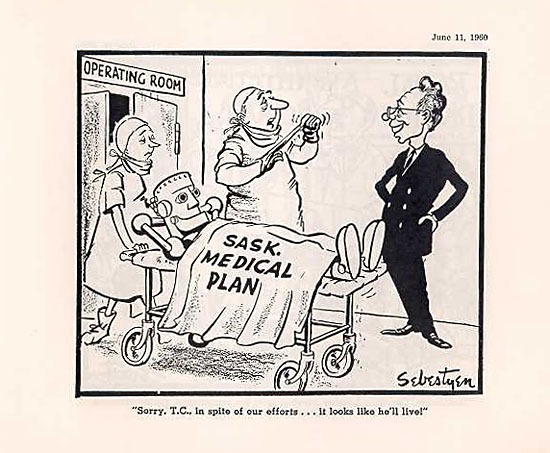
In 1962, the first government-controlled, universal, comprehensive single-payer medical insurance plan in North America was born in Saskatchewan. This triggered fierce opposition from organized medicine. The College of Physicians and Surgeons of Saskatchewan and medical associations argued doctors should retain the freedom to bill privately.
The infamous Saskatchewan Doctors strike between July 1-23, 1962, remains one of the decisive battles in Canadian social policy.
The CCF government, led by Woodrow Lloyd after Tommy Douglas’ move to federal politics, held their ground. “This was made possible by the dedication of CCF rank and file activists and a dedicated core of socialists, trade unionists, agrarian radicals, and of a small minority of courageous doctors who defied the ostracism of their colleagues. They built community clinics with the initial aim of employing doctors who defied the strike. Their long-range aim was to provide a consumer-controlled alternative to entrepreneurial fee-for-service medicine. It was the possibility that the community clinics might become really widespread and popular that really frightened the medical establishment. The same people who organized the community clinics also organized such groups as Citizens in Defense of Medicare and Citizens for a Free Press to counter the anti-Medicare propaganda.”
6. The great compromise of medicare
The Saskatchewan Doctor strike ended with the Saskatoon Agreement, a compromise that allowed physicians to remain independent practitioners rather than government employees.
This blend of public pay and private provision became a lasting feature of Canadian medicare. To this day, access to family doctors in particular has been limited by the reliance of a physician-owned business model for the delivery of primary health care.
Even so, organized medicine has never ceased to advocate varying degrees of private practice and billing flexibility.
7. 1964 The Hall Commission
In 1960, as Tommy Douglas’ government prepared to introduce public coverage for physician services, the Canadian Medical Association feared that the popularity of medicare in Saskatchewan would spread.
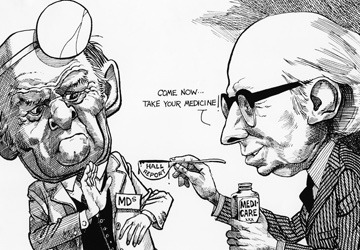
They pressed the federal government to launch a Royal Commission to examine the issue of the medical system. They hoped the commission would recommend the continuation of the existing doctor-sponsored medical insurance plans, subsidized by the state if necessary but controlled by the medical establishment. The Diefenbaker government appointed fellow Conservative and old seat-mate from law school, Mr. Justice Emmett Hall, to chair the Royal Commission.
Grass roots activists filled the hearings across the country.
The first report of the Hall Commission was released in 1964. Hall favoured a comprehensive health insurance program to be jointly financed by the federal and provincial governments (the Saskatchewan model). Emmet Hall became a strong advocate for public Medicare.
8. Public insurance to cover doctor’s services
Again following the example of Saskatchewan, the federal government passed the National Medical Care Insurance Act in 1966, saying that starting July 1, 1968, the federal government would pay about half of Medicare costs in any province with insurance plans that met the criteria of being universal, publicly administered, portable and comprehensive. This act extended public insurance to cover doctor’s services.
This represented the victory of a decades-long civil society campaign led by farmers, labour, churches, nurses, and cooperative movements.
By 1971, every province and territory had adopted medicare. The principle that medically necessary physician services should be based on need and publicly insured had become a national norm.
 9. 1970s Extra-billing and user fees expand
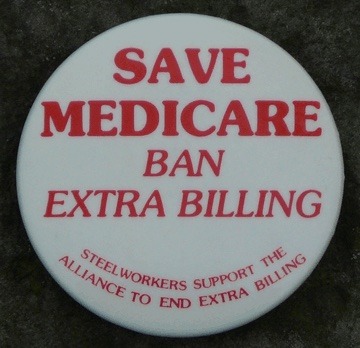
Many physicians began charging patients amounts above provincial schedules, a practice that became known as "extra-billing". Hospitals and clinics increasingly imposed user fees. In BC, hospitals had a daily surcharge rate of $9.80.
Medical associations argued that physicians should be free to:
- Charge additional fees
- Set independent prices
- Preserve private-market options
Critics argued these practices undermined universality. Led by Justice Emmett Hall, the Health Services Review raised concerns about the increase in user fees and extra billing by physicians.
10. 1984 Canada Health Act
The landmark Canada Health Act was passed unanimously by Parliament. It consolidated previous legislation and imposed penalties on provinces permitting extra-billing, user charges, or preferential access based on ability to pay.
The Act set out five criteria for federal payment eligibility: public administration, comprehensiveness, universality, portability, and accessibility.
Learn more about the evolution of Canadian medicare in part two of our Summer Series. Written by Audrey Guay, with recognition for Ayendri Riddell's resource list.