The legal battles over Medicare
 By the time the Canada Health Act (CHA) became law in 1984, Canadian medicare was a non-partisan consensus issue.
The vision for medicare had been relentlessly championed by Tommy Douglas and the New Democratic Party. Emmet Hall, a Conservative Supreme Court Judge, had chaired the Royal Commission and delivered the framework for what became the Canada Health Act. Minister of National Health and Welfare Monique Bégin, a Liberal, presented the legislation to Parliament. It was unanimously passed.
For decades, no politician dared to publicly contradict the shared Canadian value that health care should be based on need and not the ability to pay.
But make no mistake, well-organized and well-financed attacks have continued to undermine Canadian public health care and prevent its expansion to include things like Pharmacare, Dental Care, and Tommy Douglas’ suggestion of public community clinics.
In the first installment of our Summer Series, we looked at the long road of the people’s struggle to win Canadian medicare. In this second installment, we’ll look at four key moments where legal challenges threatened the public health system. They remind us that we can’t take universal support for public health care over private profit centres for granted.
1. Ontario doctors go on strike
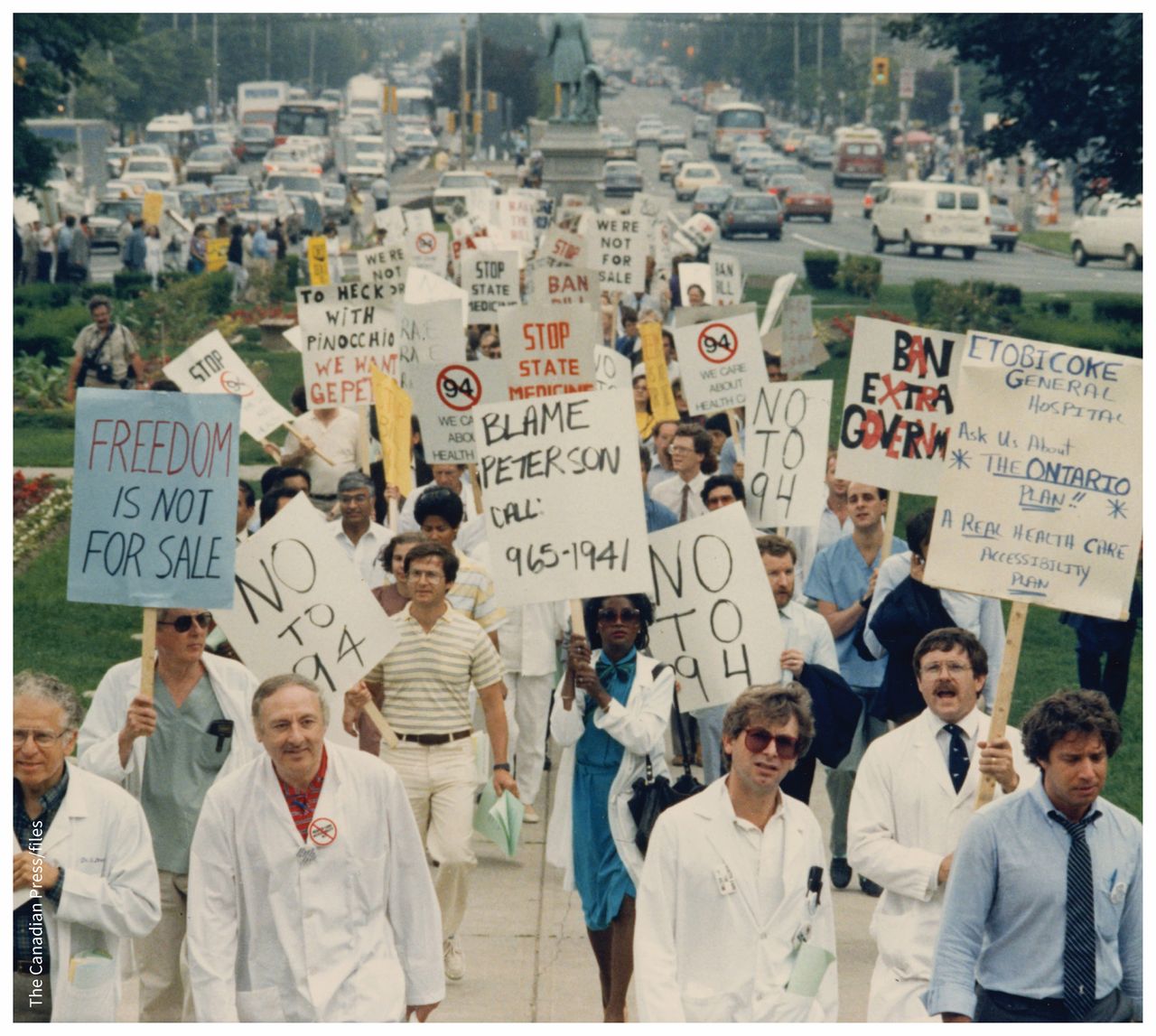
After the passing of the Canada Health Act (CHA), the Ontario Medical Association launched a legal challenge of the new legislation over physician independence, extra-billing, and provincial fee caps.
The “freedom” to charge additional fees and preserve market forces in health care, they claimed, was essential for the autonomy of the medical profession and for the physician-patient relationship.
In 1986, the Ontario government passed Bill 94, provincial legislation designed to align their medical system with the criteria in the Canada Health Act. The Ontario Medical Association objected to the new ban on extra-billing and went on strike. The 25-day strike, beginning June 12, was not fully supported by the medical profession and had very low support in the general population. The doctors conceded and eventually dropped their legal challenge to the CHA.
2. Chaouilli v. Quebec
The 2005 Chaouilli ruling was the first legal defeat for public health care legislation. In its decision, the Supreme Court struck down a Quebec law that prohibited the purchase of private health insurance for essential hospital and physician services.
Private sector advocates celebrated the decision as a doorway for duplicative private insurance and the expansion of private financing.
Medicare defenders warned that private insurance would create unequal access and drain resources from the public system. They were right.
Over the past twenty years, Quebec has seen an expansion of private clinics that cater to private insurance or private pay patients. A growing number of physicians have left the public system to practice in the private sector. The result is longer waiting times for the patients that do rely on publicly funded health care.
The trend appears to be exponential. The number of physicians leaving the public sector for private practice in Quebec was 460 in 2019, 666 in 2023, 777 in 2025, and 1064 in 2026.
Because the ruling was based on the Quebec Charter of Human Rights and Freedoms, it did not apply outside of Quebec.
3. Cambie Surgeries Corporation v. British Columbia
The Cambie Case has been widely recognized as the most significant constitutional challenge to health care in Canadian history.

Dr. Brian Day, owner of Vancouver’s for-profit Cambie Surgery Centre and a leading proponent of privatized health care, launched the challenge in 2008. He argued that not being able to privately purchase medically necessary care put people at risk of suffering on wait lists, that they were being denied the freedom to purchase health care.
The BC Health Coalition, Canadian Doctors for Medicare, and two individual patients were granted intervenor status in the case. Over the course of a fourteen year legal battle, the Coalition of Intervenors presented evidence in the courts and led public campaigns that demonstrated widespread support for public health care.
The courts reviewed extensive international evidence from across Europe and Australia that repeatedly showed that parallel private-payment systems do not reduce public wait times. Rather, they take scarce resources, including health care workers, away from the public system and place them behind a paywall.
The BC Supreme court upheld British Columbia's legislation. The case became a major victory for medicare defenders.
4. Alberta’s Bill 11 and the return of the dual-practice debate
In June 2026, Alberta brought Bill 11 into force, following through on their plan to allow physician dual practice. This change will allow doctors to participate in both publicly funded and privately paid care.
Bill 11 threatens Alberta’s public health care system by ignoring lessons learned and warnings against parallel private systems.
Dual practice is illegal under the Canada Health Act. In an Edmonton Journal article, Dr. Danyaal Raza and Dr. Braden Manns remind us that “it allows doctors to provide care to publicly and privately funded patients, at the same time, choosing patient-by-patient who will pay much higher private fees for faster care, and who will wait for public care.”
Alberta Friends of Medicare, the Canadian Health Coalition, and defenders of public health care across the country now find ourselves in another wave of organizing to ward off the profit motive from public health care once again.

In March, the BC Health Coalition held a rally and urged MP Hedy Fry, in her role as Chair of the House of Commons Standing Committee on Health, to publicly defend and enforce the Canada Health Act
After listening to speakers at the rally, Fry addressed the crowd and clarified her position on Alberta’s proposed legislation. “I want to talk about Alberta’s Bill 11 here. There is no doubt that it absolutely contravenes the Canada Health Act,” she said. Fry spoke about the serious concerns a two-tier system would raise for equity and access in Canada’s public health care system.
The federal government has the power to apply financial penalties when provincial legislation doesn’t comply with the Canada Health Act’s principles of: public administration, comprehensiveness, universality, portability, and accessibility.
All governments have the responsibility to bring in proven public solutions that would improve access to health care for all Canadians.
Legal battles over medicare about profit, not access
The legal battles over medicare have never really been about quality care or wait times. The debate has been whether health care should be treated as a public service or a marketplace.
Whether the issue was extra-billing, user fees, private insurance, private surgical clinics, or physician dual practice, each legal challenge has been built on the same promise: that allowing more private payment will improve access to care. Yet decades of evidence from Canada and around the world tell a different story. Private financing does not create more doctors, nurses, operating rooms, or hospital beds. It simply changes who gets access to them first.
The lesson from forty years of legal battles is clear.
If governments are serious about improving access, the solutions are well known: invest in the public system, train and retain health care workers, expand team-based primary care, and strengthen universal programs like Pharmacare and Dental Care.
Defending medicare is about choosing a system organized around people's needs instead of around profit.
Learn more about the evolution of Canadian medicare in part one of our Summer Series. Written by Audrey Guay.