A People's Struggle: The Community Clinics That Won Public Health Care
When we consider direct actions that drive social change, we often think of marches, strikes, and sit-ins. These are powerful tools in the struggle for justice. Yet there is another form of direct action, equally transformative but often overlooked: building the alternative. This means creating systems that challenge injustice by embodying what a just society should provide. It is not just a rejection of the status quo. It is the construction of something better.
That is exactly what unfolded in Saskatchewan in the early 1960s. It is the story of Community Health Centres. When the medical establishment tried to crush Medicare by withdrawing care and disrupting services, the grassroots were ready. Community members, and courageous health care workers came together to build nonprofit, community-governed, multi-disciplinary team-based health clinics across the province. By March 1963, nearly 15,000 families, representing more than 50,000 people, had joined the movement and 25 community clinics had established facilities.
What the medical establishment did next has shaped the health care crisis we face today. But the lessons from that struggle continue to offer a powerful roadmap toward a better future.
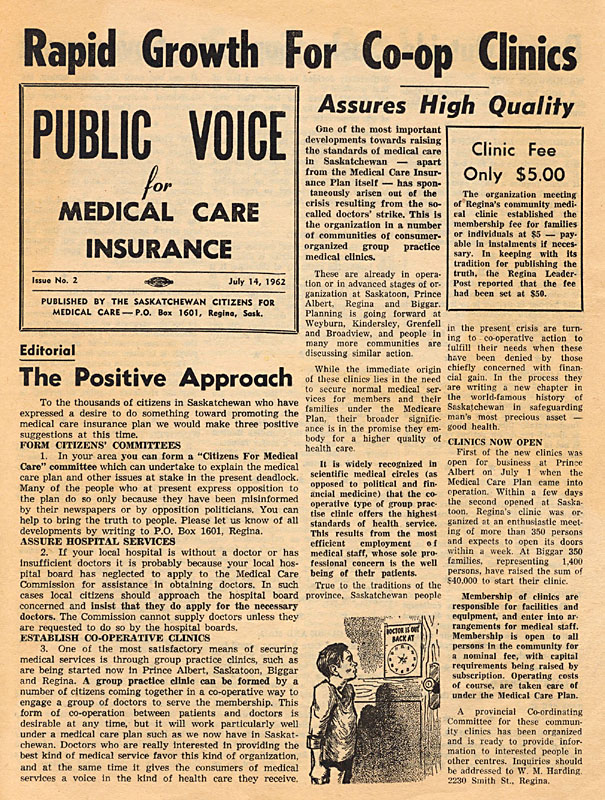 IMAGE: Public Voice for Medical Insurance Issue 2: 14 July 1962

Community Health Centres embody a higher quality of health care
In an attempt to crush the dream of universal public health care, the medical establishment declared that physicians would withdraw their services once Medicare came into force. At one minute past midnight on July 1, 1962, most doctors in the province closed their doors. That same night, a baby died of meningitis as his parents drove through the darkness, frantically searching for care.
Grassroots community groups, committed to universal public health care, organized clinics that provided care in defiance of the medical establishment. The first of the Community Clinics opened in Prince Albert on July 1, as the medical establishment closed its doors. The idea spread quickly. Within days, a second clinic was operating in Saskatoon. In Regina, more than 300 people attended an enthusiastic organizing meeting ahead of the clinic’s official launch. In Biggar, 380 families, representing 1,400 people, came together to establish their own facility.
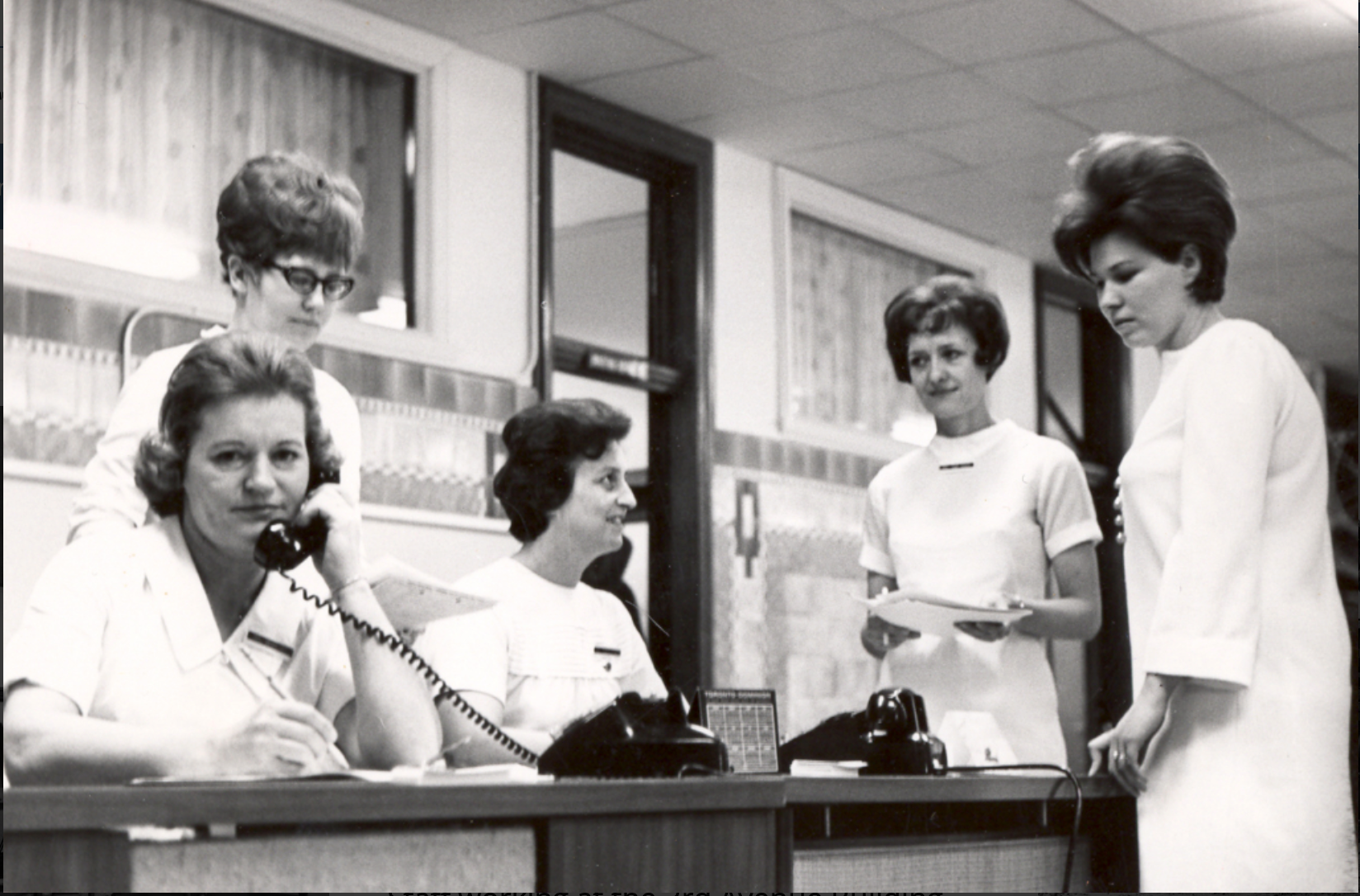
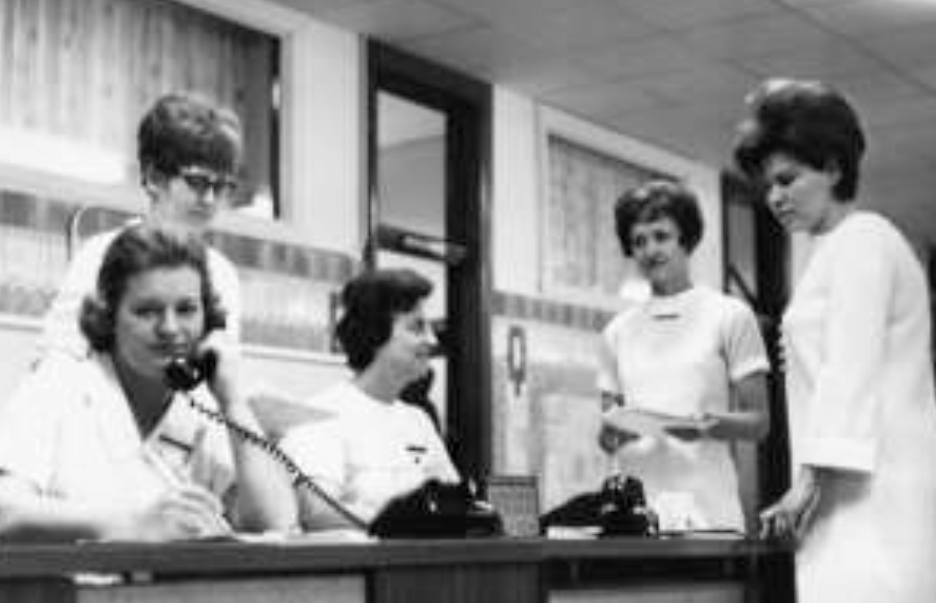 IMAGE: Staff working at the Saskatoon Community Clinic
The Community Health Services (Saskatchewan) Association was formed to help coordinate the expanding network of clinics. Health workers and volunteers traveled across the province, assisting local communities in setting up their own centers.
The nurses, doctors and other healthcare who staffed these clinics risked repression by defying the medical establishment. They did so because they believed in a better model of care. Nonprofit, community-governed, team-based health services marked a paradigm shift in health care delivery. It moved away from the transactional nature of medicine toward a system focused not only on treating illness but also on preventing it and improving overall health.
Public Voice for Medical Insurance Issue 2: 14 July 1962:
While the immediate origin of these clinics lies in the need to secure normal medical services for members and families under the Medicare Plan, their broader significance is in the promise they embody for a higher quality of health care...
The Opposition of the Medical Establishment
In 1944, the Co-operative Commonwealth Federation was elected in Saskatchewan on a platform of sweeping health care reform. The medical establishment quickly mobilized in opposition, including the Canadian Medical Association and the Colleges of Physicians and Surgeons. Their counter proposal to the Advisory Planning Committee on Medical Care was identical to the U.S. two-tiered model.
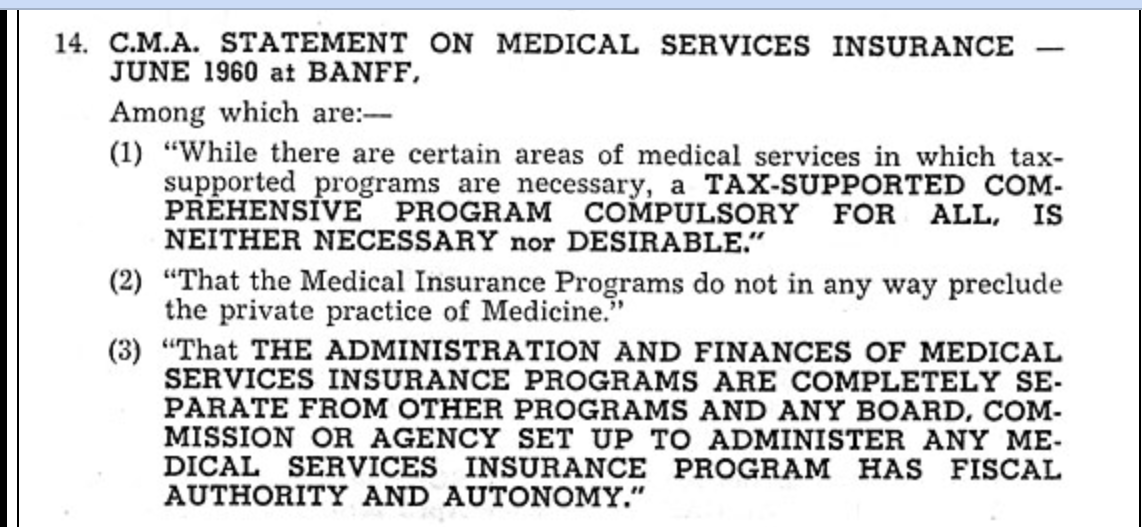 IMAGE: Statement made at the 1960 annual meeting of the Canadian Medical Association in Banff
The Canadian Medical Association and the Colleges of Physicians and Surgeons held two distinct roles: one represented physicians’ financial interests, and the other responsible for licensing and regulation. By blurring these boundaries, they used their institutional authority to control policy and physician culture.
In Saskatchewan, where droughts had devastated rural communities, physicians benefited from salaried arrangements that provided stable incomes in areas with high needs and limited resources. Urban doctors, especially specialists and surgeons who delivered episodic care, found the fee-for-service model more lucrative. They opposed salaried agreements, fearing these would become more widespread and threaten their earnings. As early as 1933, the Saskatchewan Medical Association endorsed private insurance as the only acceptable model of care, leaving rural physicians in a vulnerable position. When rural municipalities attempted to hire foreign-trained doctors willing to work on salary, the College refused to license them.
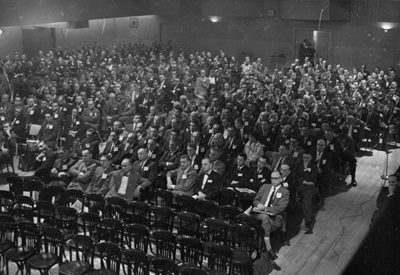
One of the most striking abuses of power came when the College of Physicians and Surgeons used mandatory dues collected from all licensed physicians to fund an anti-Medicare campaign during the 1960 provincial election. This action was widely condemned as a serious misuse of its regulatory authority.IMAGE: The College of Physicians and Surgeons passing a resolution declaring that physicians would withdraw their services once Medicare came into force.
The medical establishment vocally opposed the Community Clinics movement. These clinics posed a direct threat to their profits and their control over the health care system. The treatment of Community Clinic doctors by the establishment had lasting and devastating consequences.
At a press conference on May 11, 1963, Dr. Samuel Wolfe, speaking on behalf of physicians working in community health centres, condemned what he described as a coordinated campaign of hostility toward clinic-affiliated doctors. He viewed this hostility as deliberate and widespread, intended to deter new physicians and drive out those already working in the clinics.
One of the key issues he raised was the widespread denial of hospital privileges to clinic-affiliated doctors. As he wrote in the CMA Journal on August 1, 1964:
More community clinic doctors have experienced difficulties in obtaining hospital privileges than all other doctors combined in the history of the province of Saskatchewan.
Physicians who publicly challenged the authority of the medical establishment faced reprimands, suspensions, and even threats to their licenses.
In 1962, the College of Physicians and Surgeons ultimately backed down and agreed to the implementation of a public single-payer system. But the victory came at a cost. The College imposed a critical restriction: funding for health care outside hospitals would be limited to physician services. This was a direct blow to the clinic movement, undermining the global budgets needed to sustain nonprofit, community-governed, multi-disciplinary team-based care.
Despite the repression they faced many of the clinics continued to operate for decades and five clinics established in 1962 remain today.
The second phase of Medicare calling us to action
Community Clinics were central to the creation of public health care in Canada. Yet the concession that tied all primary health care funding to physician compensation ensured they could not become part of its foundation, a compromise that has led directly to the health care crisis we face today.
Instead of ensuring that primary care was universally available and publicly funded, as hospitals and schools are, access became dependent on individual family physicians and their ability to run small businesses while also providing essential care. As a result, 6.5 million Canadians today lack access to a family doctor or nurse practitioner.
Tommy Douglas, the political leader of the Medicare movement, foresaw these challenges, often reminding the public that Medicare was never a finished project. At the 1979 S.O.S. Medicare Conference, he said:
I am concerned, as many people are, about Medicare — not with its fundamental principles, but with the problems which we knew would arise. Those of us who talked about Medicare back in the 1940s and 50s and 60s kept reminding the public that there were two phases for Medicare. The first phase was to remove the financial barrier between those who provide health services and those who need them... The second, the harder, is to alter our delivery system so as to reduce costs and place the emphasis on preventive medicine... We must now move increasingly toward group practice, whether it is community clinics, cooperative clinics, or clinics set up by the doctors themselves.
Other forms of direct action are essential in resisting injustice, but the true power of building alternatives lies in their ability to light the path forward. The health care crisis we face today is not without a solution. We need a movement to finish what was left unfinished 63 years ago.
We should take hope. The story of Community Clinics in the fight for Public Health Care is a reminder that a better world is possible. And while there is still much to resist, there is just as much to believe in and fight for.